

Raleigh vs Durham is the original Triangle decision. The two cities anchor opposite corners of the Research Triangle, sit about 28 miles apart by road, and share one airport, one research park, and one job market. Yet they feel like different worlds. Raleigh is the state capital, the bigger city at roughly 500,000 residents, with the larger school system and more homes to choose from. Durham, the Bull City, is smaller at roughly 291,000 residents, older in character, closer to Research Triangle Park, and home to Duke University. On price, Durham’s typical home value runs about $39,000 below Raleigh’s as of late 2026, but Durham’s property tax rate runs higher, which narrows the real cost gap. If you are new to the area, start with what Raleigh is known for and our Raleigh relocation guide, then use this head-to-head guide to pick your corner of the Triangle.
Quick take: As of late 2026, Zillow’s typical home value sits at $428,671 in Raleigh and $389,634 in Durham, a gap of about $39,000 in Durham’s favor. Recent median sale prices, though, landed almost even (Redfin, three months ending August 2026: Raleigh $422,221, Durham $424,719), because the mix of homes that sold differed. Durham charges more property tax: 99.13 cents per $100 of assessed value for fiscal 2025 to 2026, versus 90.91 cents in Raleigh. Choose Durham for Duke, a shorter Research Triangle Park commute, historic neighborhoods, and a lower typical entry price. Choose Raleigh for more inventory, the Wake County school system’s scale, lower taxes, and capital city amenities.
1. Raleigh vs Durham at a glance
| Raleigh | Durham | |
| Role | State capital, Wake County seat | Durham County seat |
| Nickname | City of Oaks | Bull City |
| Population | About 499,825 (2024 est.) | About 291,467 (2024) |
| Typical home value (Zillow, Aug 2026) | $428,671 | $389,634 |
| Median sale price (Redfin, 3 mo. to Aug 2026) | $422,221 | $424,719 |
| Median days on market (Redfin) | 39 days | 35 days |
| Sale-to-list ratio (Redfin) | 98.2% | 98.4% |
| Combined property tax (FY 2025-2026) | 90.91 cents per $100 | 99.13 cents per $100 |
| Median household income (2024) | $85,395 | $81,619 |
| School system | Wake County Public School System | Durham Public Schools |
| Anchor institutions | NC State University, state government | Duke University, Duke Health, NC Central University |
| Average one-way commute (2024) | About 23 minutes | About 22 minutes |
Home value figures are Zillow typical home values through August 2026, via Stacker and local market reporting of Zillow and Redfin data. Tax rates are the adopted fiscal 2025 to 2026 county plus city rates (Durham County and City of Durham budget releases; Wake County and City of Raleigh rates as compiled for 2026). Population and income are U.S. Census Bureau ACS 2024 figures via Data USA.
2. Home prices: what your budget buys in each city
Start with the number most buyers quote, and then look past it. Zillow’s typical home value, which estimates the middle tier of all homes in each city, put Raleigh at $428,671 and Durham at $389,634 in August 2026. On that measure Durham is about $39,000, or roughly 9 percent, cheaper, and its typical value fell 3.4 percent over the year while Raleigh’s eased about 1.7 percent.
Now the twist. Redfin’s median sale price for the three months ending August 2026 was $422,221 in Raleigh and $424,719 in Durham, essentially tied. Both numbers are true; they measure different things. The typical value covers every home in the city, including the older, smaller housing stock that makes Durham more affordable overall. The median sale price covers only the homes that actually sold in that window, and Durham’s sold mix in mid 2026 included enough renovated in-town homes to pull its median up to Raleigh’s level. The lesson for buyers: citywide medians set expectations, but your real comparison is house against house in specific neighborhoods.
What the money buys also differs in kind. Raleigh is the region’s volume market, with 1,465 homes sold in that same three-month Redfin window against 946 in Durham, and a deep bench of choices: downtown condos, Inside the Beltline historic homes, established suburbs in North Raleigh, and new construction pushing toward Wake Forest, Garner, and Knightdale. If your first choice falls through in Raleigh, there is usually a second one nearby. Our guide to what cities are in Wake County shows how much variety sits within a short drive of the capital.
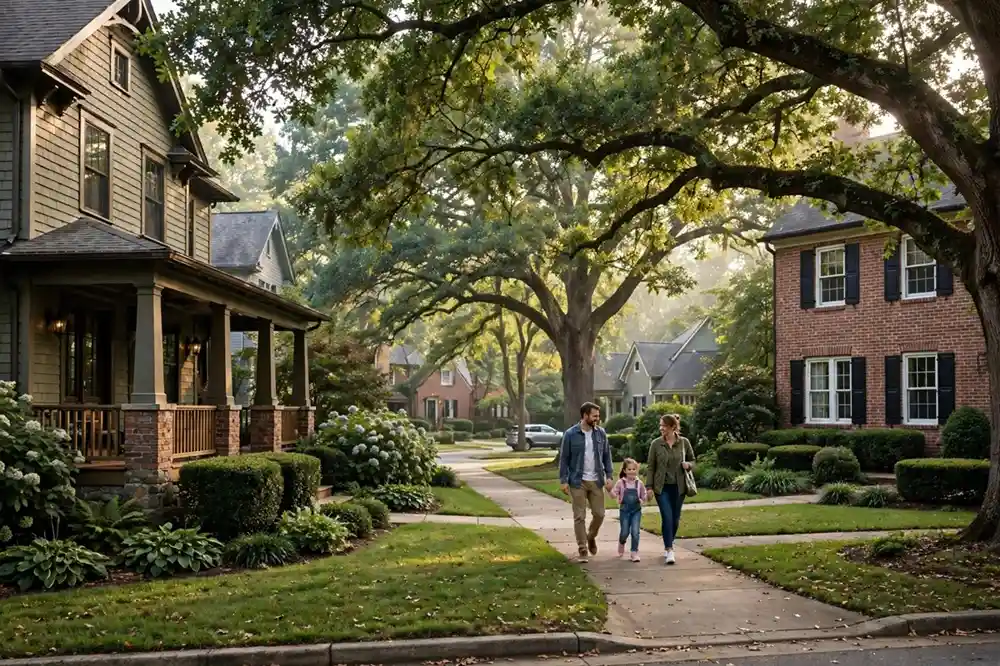
Durham’s stock runs older and more compact near the center: early 1900s bungalows and mill houses around downtown and Duke, mid-century ranches in established neighborhoods, and newer subdivisions concentrated in south Durham along the NC 54 corridor. Buyers who want historic character and a porch-front street often find more of it per dollar in Durham. Buyers who want a newer home with a two-car garage and an HOA pool will find that product in both cities, but with more competing listings in Raleigh and its Wake County suburbs.
Renting first? Do not assume Durham rents mirror its lower purchase prices. One September 2026 rental dataset (Doorstead) put median rent at $1,603 in Raleigh and $1,714 in Durham, with Durham homes leasing in about 9 days. Steady demand from Duke and the medical center keeps well-located Durham rentals tight, so a rent-first strategy deserves its own neighborhood-level check in either city.
3. Property taxes and the true monthly cost
This is where the Raleigh vs Durham math flips. For fiscal 2025 to 2026, a home inside Raleigh city limits pays a combined Wake County plus City of Raleigh rate of 90.91 cents per $100 of assessed value. A home inside Durham city limits pays 99.13 cents per $100: Durham County at 55.42 cents plus the City of Durham at 43.71 cents, rates both governments adopted after Durham County’s January 1, 2025 revaluation.
| Assessed value | Raleigh annual tax (90.91c) | Durham annual tax (99.13c) | Durham extra per year |
| $400,000 | $3,636 | $3,965 | $329 |
| $425,000 | $3,864 | $4,213 | $349 |
| $500,000 | $4,546 | $4,957 | $411 |
On a $425,000 assessed home, Durham costs about $349 more per year, roughly $29 a month. That is real money, but it only claws back a small part of the roughly $39,000 typical price gap. Run the full payment, not just the rate: a lower purchase price in Durham usually still wins the monthly payment comparison, while Raleigh wins if you are comparing two homes at the same price.
Two cautions apply in both cities. First, your tax bill uses the county’s assessed value, not your purchase price, and the two can differ, especially just after a revaluation. Wake County last revalued in 2024 and Durham County in 2025, so recent buyers in both places should budget from the current assessment and confirm it with the county tax office. Second, county lines do not follow city reputations: a small part of Raleigh sits in Durham County, and a small part of Durham reaches into Wake County. Check the county on the specific parcel before you estimate taxes, insurance, or school assignment.
4. Market pace and competition in 2026
Both markets have cooled from the frenzy years into something a prepared buyer can actually navigate. In Redfin’s three months ending August 2026, Raleigh homes took a median 39 days to sell and Durham homes 35 days. Sale-to-list ratios were 98.2 percent in Raleigh and 98.4 percent in Durham, and 42.5 percent of Raleigh listings took a price drop in that window. Both cities rated as somewhat competitive, averaging about two offers on a typical home.
In practice, the difference is depth, not speed. Raleigh’s larger market (1,465 sales in that window versus 946 in Durham) means more comparable sales to price against, more fallback options, and more room to negotiate on homes that sit past 30 days. Durham’s smaller in-town market can still move quickly for renovated homes near Duke and downtown, where supply is genuinely limited. In both cities, the winning strategy in 2026 is the same: get fully underwritten before you tour, price your offer from the freshest comparable sales on that street, and keep inspection and appraisal terms realistic instead of waiving protections to win a bidding war that the data no longer justifies.
5. Jobs, commute, and Research Triangle Park
Economically, Raleigh and Durham are one labor market with two home bases. Research Triangle Park, the largest research park in the United States at about 7,000 acres with more than 300 companies and about 65,000 workers, sits between them. Most of the Park lies in Durham County, with about a quarter in Wake County, which is why the commute math tilts west: typical drives to RTP run about 10 to 20 minutes from Durham and about 20 to 35 minutes from most Raleigh neighborhoods, always depending on traffic on I-40.
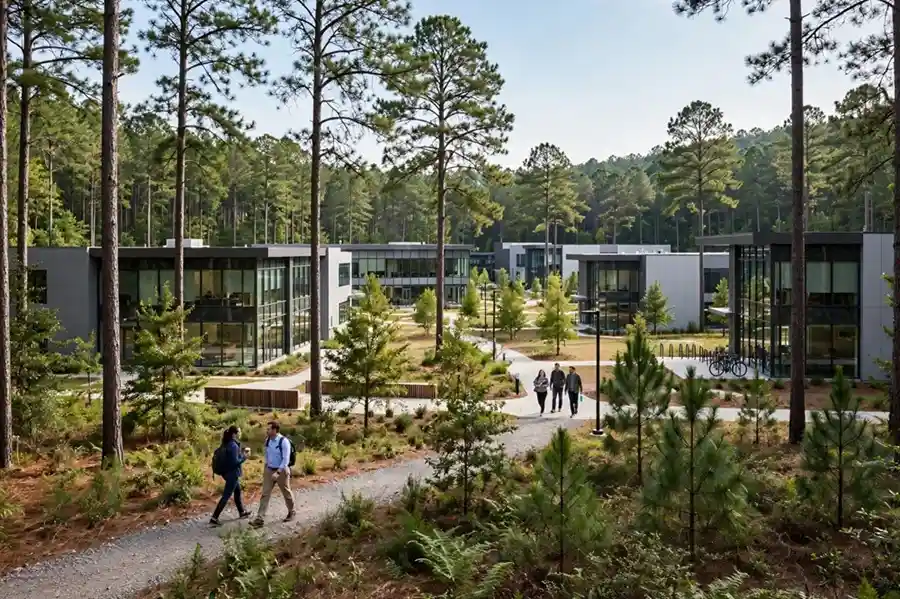
Beyond the Park, each city has its own anchors. Raleigh runs on state government as the capital, NC State University, and a broad base of technology and professional services employers. Durham runs on Duke University and Duke University Health System, North Carolina Central University, and a life sciences cluster that grew up around the Park. Day to day, average one-way commutes are nearly identical, about 23 minutes in Raleigh and about 22 minutes in Durham (ACS 2024).
The two downtowns are about 28 miles apart by road, with Raleigh-Durham International Airport (RDU) between them, roughly 11 miles from downtown Raleigh and about 10 miles from downtown Durham. Plenty of Triangle households live in one city and work in the other, but I-40 at rush hour is the region’s least loved commute. If you plan to cross it daily, drive it at 8 a.m. on a weekday before you make an offer, not after. Buyers weighing the western Wake County suburbs as a middle option should also read our Raleigh vs Cary comparison for home buyers, and explore the communities Patty serves across the Triangle.
6. Schools: two county systems, two different searches
School structure is one of the clearest real differences between the two cities. Raleigh students are assigned to the Wake County Public School System, the largest district in North Carolina, with more than 161,000 students across 203 schools in the 2025 to 2026 school year. Its scale brings a long list of magnet programs, academies, and both traditional and year-round calendars, and it also brings the complexity that comes with a very large system: base school assignments, capped schools, and magnet lotteries all need checking address by address.
Durham students attend Durham Public Schools, a smaller county system with 31,865 students across 57 schools (NCES, 2024 to 2025). Families choose Durham for its own magnet and themed programs and for the tighter community feel of a district one fifth the size, where a single school community is easier to get to know. Durham also has a notably active charter school sector, which many local families factor into their planning.
The honest buying advice is identical in both counties. Never buy a district reputation; buy a specific assigned school. Confirm the base elementary, middle, and high school for the exact address with the district’s official assignment lookup, ask whether any of those schools are capped for new enrollments, and visit in person if schools are driving your decision. Patty walks through that address-level check with every relocating family, because it changes which side of the Triangle a home search should start on.
7. Lifestyle and neighborhood character
Raleigh feels like a capital city that grew up in a forest. The City of Oaks spreads across nearly 150 square miles of oak canopy, with a modern downtown, the free state museums, NC State’s campus energy, and a long list of neighborhoods that each work like small towns. If your weekends run on farmers markets, greenway rides, and big-city dining variety, Raleigh’s scale is an advantage. Our guide to things to do in Raleigh and our take on whether Raleigh is a good place to live cover that daily-life picture in depth.
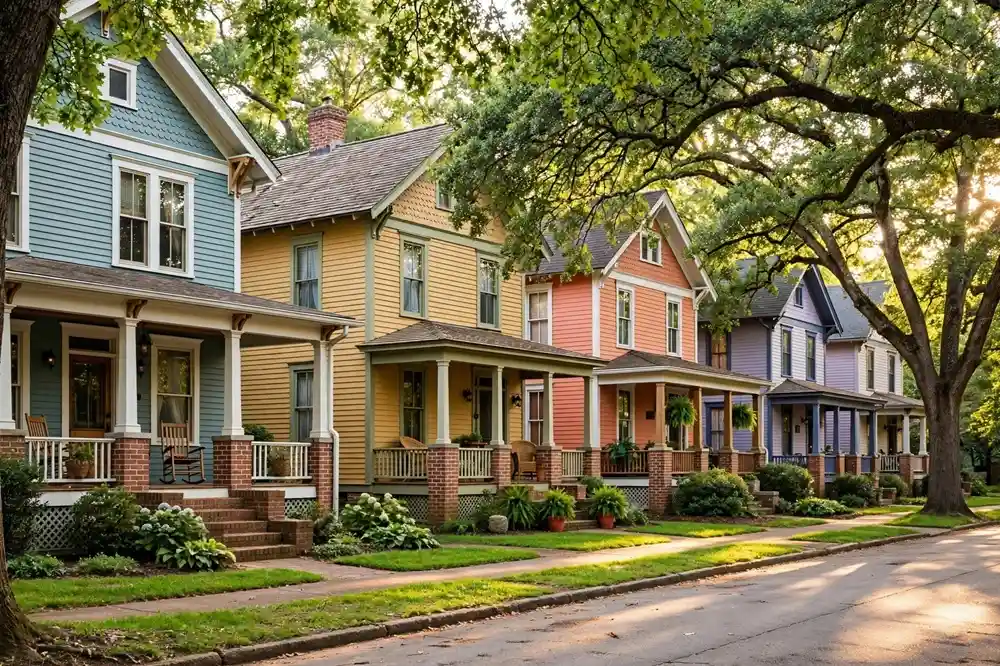
Durham feels smaller, older, and prouder of it. The Bull City’s tobacco warehouse past is now its downtown identity, with brick factory buildings converted into offices, restaurants, and lofts around the American Tobacco Campus, Durham Bulls baseball a short walk away, and a food and arts scene that punches above the city’s size. Neighborhoods near downtown and Duke trade yard size for walkability and character. Buyers who describe Raleigh as a little too polished often light up in Durham, and buyers who want newer, quieter, and more predictable often land the other way. Neither reaction is wrong; it is the single most useful signal in the whole comparison, so spend a full day in each city before you decide.
What you do not have to choose between: weather, the airport, the Park, and the wider Triangle. Both cities share the same mild four-season climate (yes, it does occasionally snow in Raleigh, and Durham gets the same sky), the same RDU access, and the same regional job market. This decision is about daily texture and school and tax specifics, not about leaving anything major behind.
8. Who should buy where
| Raleigh | Durham | |
| Best for | Buyers who want maximum choice, Wake County schools scale, and capital city amenities | Buyers who want character, a lower typical entry price, and the shortest RTP and Duke commutes |
| Typical value edge | Higher typical value ($428,671) but far more listings at every price point | Typical value about $39,000 lower ($389,634) with more historic stock near downtown |
| Tax edge | Lower combined rate: 90.91 cents per $100 | Higher combined rate: 99.13 cents per $100 |
| Watch out for | Sprawl and longer drives across a 150 square mile city; I-40 commute if you work in RTP or Durham | Smaller inventory; address-level school and tax checks matter even more; city and county lines vary by parcel |
Choose Raleigh if: your job is in state government, at NC State, or in east Raleigh; you want the widest possible choice of neighborhoods and home styles; schools are a top priority and you want the Wake County system’s magnet depth; or you simply want the bigger city’s dining, museums, and events calendar.
Choose Durham if: your job is at Duke, Duke Health, or in Research Triangle Park; you love historic homes and a walkable, arts-driven downtown; you want the lower typical entry price; or Chapel Hill access matters to you, since Durham sits on its doorstep.
Still torn? Use this one-weekend test. Saturday in Raleigh: tour three homes, walk one neighborhood at dusk, and time the drive to your office. Sunday in Durham: do the same three things. Then compare the two spreadsheets side by side, total monthly payment including taxes, commute minutes, and assigned schools. The city that wins two of those three columns is almost always your answer.
Frequently asked questions
Is it cheaper to live in Raleigh or Durham?
For buyers, Durham usually has the lower entry price: Zillow’s typical home value was $389,634 in Durham versus $428,671 in Raleigh in August 2026. Durham’s property tax rate is higher though (99.13 cents versus 90.91 cents per $100), which adds roughly $349 a year on a $425,000 assessed home. Rents do not follow the same pattern; a September 2026 Doorstead dataset put median rent slightly higher in Durham ($1,714) than Raleigh ($1,603). Overall the cities sit in a similar cost band, and the specific neighborhood matters more than the city line.
Which city has better schools, Raleigh or Durham?
They run different systems. Raleigh is served by the Wake County Public School System, North Carolina’s largest district with more than 161,000 students and 203 schools, known for the depth of its magnet and academy options. Durham Public Schools is much smaller at 31,865 students and 57 schools, with its own magnet programs and a large charter sector. District-wide labels hide the real variation, so compare the specific schools assigned to an address before deciding.
How far apart are Raleigh and Durham?
The downtowns are about 28 miles apart by road, roughly 21 miles in a straight line, connected by I-40 and NC 147. Raleigh-Durham International Airport sits between them, about 11 miles from downtown Raleigh and about 10 miles from downtown Durham. Off peak, the drive is about half an hour; at rush hour, budget considerably more.
Which city is closer to Research Triangle Park?
Durham. Most of Research Triangle Park’s 7,000 acres lie in Durham County, and typical drives run about 10 to 20 minutes from Durham neighborhoods versus about 20 to 35 minutes from most of Raleigh. If you will commute to the Park daily, that difference is worth real money and time over a mortgage.
Are property taxes higher in Durham than in Raleigh?
Yes, at current rates. For fiscal 2025 to 2026, the combined city and county rate inside Durham is 99.13 cents per $100 of assessed value (Durham County 55.42 cents plus City of Durham 43.71 cents). Inside Raleigh it is 90.91 cents per $100 (Wake County plus City of Raleigh). On the same assessed value, Durham costs about $82 more per year for every $100,000 of value.
Which market is more competitive for buyers in 2026?
They are close. Redfin data for the three months ending August 2026 showed a median 39 days on market and a 98.2 percent sale-to-list ratio in Raleigh, versus 35 days and 98.4 percent in Durham, with both rated somewhat competitive. Raleigh offers more total choice (1,465 sales versus 946 in that window), which gives buyers more fallback options and more negotiating room on slower listings.
Can I live in Durham and work in Raleigh, or the other way around?
Yes, many Triangle residents do exactly that, and both cities share one job market centered on Research Triangle Park. The tradeoff is the I-40 or NC 147 commute at rush hour. Before buying across the Triangle from your job, test the drive at your real commute time on a weekday, and weigh those minutes against the price, school, and lifestyle differences in this guide.
The bottom line for home buyers
Raleigh vs Durham for home buyers is not a contest with one winner. It is a fit decision. Durham gives you the Bull City package: Duke and the Park on your doorstep, historic streets with real character, and a typical home value about $39,000 below Raleigh’s, balanced against a higher tax rate and a smaller pool of listings. Raleigh gives you the capital package: more homes, more neighborhoods, more school options, lower taxes, and a bigger city’s calendar, balanced against higher typical prices and more sprawl. Both put you in the same job market, under the same Carolina sky, about half an hour from each other. Patty Owens, a Raleigh REALTOR with Compass serving the Research Triangle, helps buyers compare Raleigh and Durham street by street, from tax parcel checks to school assignment lookups. Book a Call at 919-602-0612 or through the contact page to talk through which city fits your move, or keep researching with the Raleigh relocation guide and Moving to Raleigh, NC.